OpenAI added a hosted browser to its Agents API on September 29. For a business commissioning an integration, the useful question is what the application can safely let an agent access. Start with a task whose account permissions prevent changes, and check the result before expanding access.
What changed, and when
Announcement date: September 29, 2026. Analysis edition: October 1, 2026.
OpenAI’s API changelog records the computer-use addition on September 29. The Agents API itself entered public beta on September 10. This is a developer integration: OpenAI manages the agent harness, while an application supplies tools and chooses an execution environment. The Agents API overview describes durable sessions and managed orchestration and recovery.
Our September 30 news edition covered dots, an ongoing-agent product. This follow-up examines the developer-facing browser capability and its operational boundaries. The announcement predates this edition; it is not October 1 breaking news.
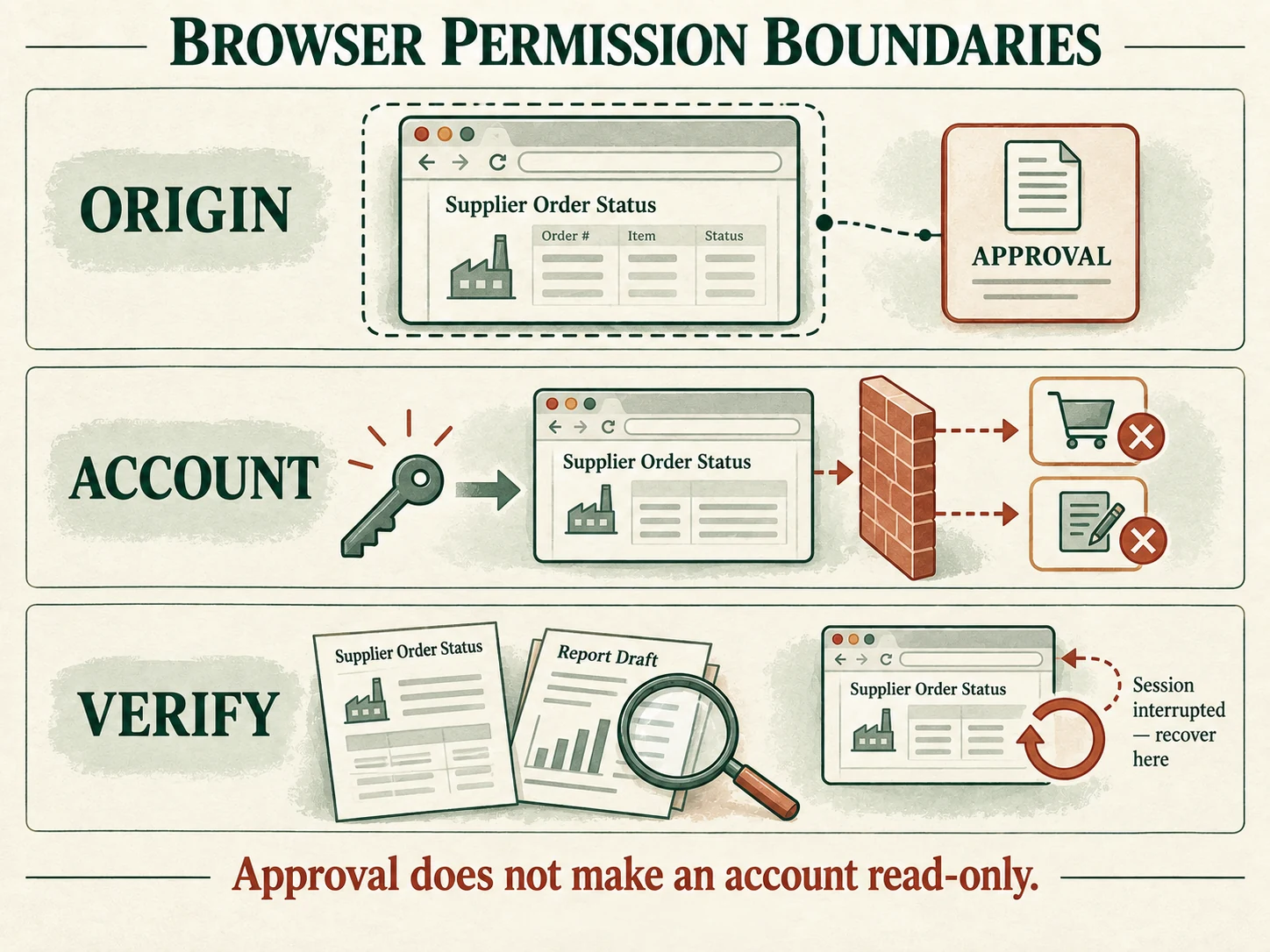
Website approval does not guarantee action approval
OpenAI’s computer-use documentation says the application handles approval for each website origin and any sign-in request. Network permission alone does not approve a website. An origin is the combination of a website’s scheme, hostname and port.
The same documentation cautions that origin approval does not enforce confirmation before individual consequential actions. For a guaranteed boundary, restrict the browser to resources that cannot perform those actions, or use a browser runtime you control. A confirmation tool depends on the agent invoking it.
Documented sign-in support includes email addresses, passwords and verification codes; passkeys and QR-code sign-in are unsupported. Only the main agent can request authentication. Authentication requests expire after five minutes. If delivery is uncertain, retrieve the same session before deciding whether to retry. A recorded authentication response is not proof of successful sign-in. These are documented limitations, not results of an Inquory test.
A business trial with a checkable result
Inquory’s interpretation: a useful first trial could read a supplier portal’s order status and draft a report for a staff member. This is a proposed example, not a customer case study. Use a test account or appropriately sanitized records, and confirm that its permissions prevent purchases, cancellations and record changes. “Read only” in a prompt is insufficient if the account can still perform those actions.
Ask the developer to demonstrate the following before introducing a live account:
| Trial question | Evidence to inspect |
|---|---|
| Can this account change anything? | Account permissions and a test showing that writes are unavailable |
| Which websites can it reach? | Named destinations, permitted redirects and the displayed approval request |
| What happens after an interrupted sign-in? | Recovery of the existing session without blindly resending the task |
| Did the report preserve the facts? | A comparison with the actual portal record, including missing or uncertain details |
| What data remains afterward? | The application’s credential, screenshot, logging and session-cleanup behavior |
Keep an operator available for sign-in and exceptions. Stop the trial if it reaches an unexpected destination, invents a status or cannot establish whether an action completed. Extend the CRM handoff checklist with the portal’s own acceptance criteria. Use the AI pilot measurement guide to record the baseline, review time and failed cases.
What will it cost?
OpenAI’s Agents API overview separates charges for the selected model, OpenAI tools and hosted containers. It does not give one universal price for a completed browser task. The practical budget depends on the work performed and environment usage.
Inquory’s interpretation: record the billed components for each trial alongside retries, elapsed time and staff corrections. Compare the final usable report with the manual process. A successful demonstration alone does not establish recurring savings. Our break-even worksheet can organize measured inputs; hypothetical savings remain hypothetical.
About this analysis
Inquory Research prepared this article with AI assistance and checked the linked primary sources on October 1, 2026. We have not tested this API, Canadian account access, portal compatibility, reliability or task cost. Product behavior is attributed to OpenAI’s documentation; the trial and interpretations are proposed Inquory methods. The original cover is an AI-generated conceptual illustration, not a software screenshot or photographed event. See our editorial method, AI-use disclosure and corrections policy.