Google announced Gemini 4 Argon on September 30, 2026, with an initial rollout to selected Fairwind cyber defenders. Wider access is planned, without a stated date. Inquory’s interpretation: a published token price gives a business a planning input. A usable procurement decision also needs confirmed access, operating limits and a supported service.
What changed on September 30
Announcement: September 30, 2026. Analysis edition: October 1, 2026. Google’s announcement names paid API customers and Google AI Ultra subscribers as the first audiences for broader release. It does not say that ordinary API customers can use Argon now.
The Fairwind Program vets applicants, restricts approved use to defensive and research work, and prohibits partners from sharing or selling model access. Inquory’s interpretation: a supplier’s participation does not establish your organization’s entitlement to use the model. Ask for the actual access channel and permitted purpose.
Announced prices and a limit worth reading carefully
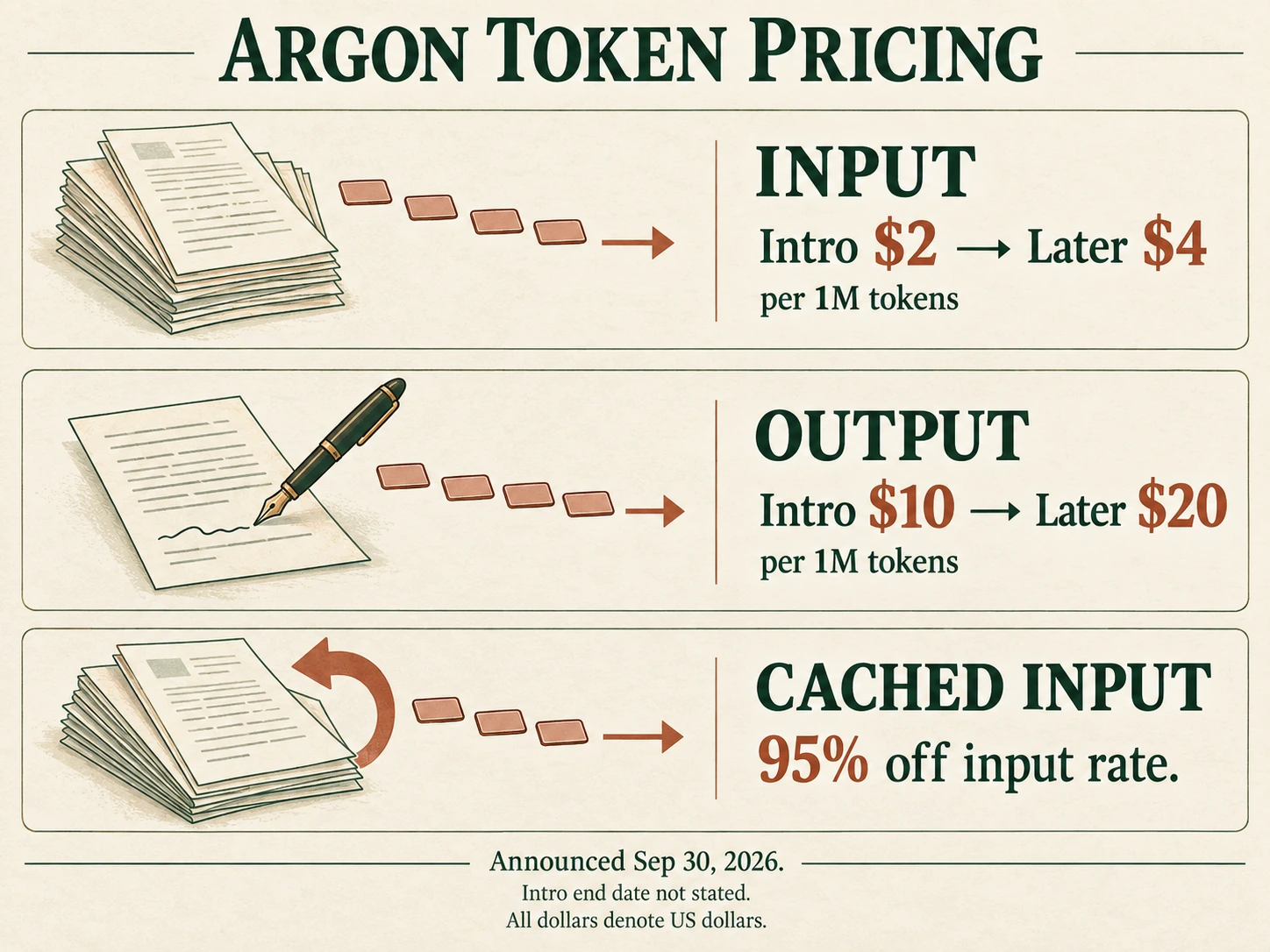
Google says introductory rates will be US$2 per million input tokens and US$10 per million output tokens, later rising to US$4 and US$20. It gives no introductory-period end date. Cached input is priced 95% below the input rate. Google describes a 1M output-token limit, up from 64K; this is an output limit, not an input-context specification.
On October 1, our checks found no Argon entry in the public Gemini API pricing page or DeepMind model-card index. This is a dated observation of those pages, not proof that private documentation is unavailable.
Inquory’s interpretation: request a written specification for the channel you can actually obtain. Establish the exact model ID, region, throughput, available tools and billing rules before estimating how much work a budget will buy. A larger allowed output does not establish a typical output length, completion time or successful-task rate.
A buyer’s evidence worksheet
This is Inquory’s proposed procurement worksheet, not a report of an Argon deployment we tested. Record an answer and supporting document for each row before scheduling a trial that depends on the model.
| Decision | Evidence to request |
|---|---|
| Can we start? | Confirmed access channel, eligible account, permitted use and available start date. |
| What are we buying? | Exact model ID and version, region, supported tools, input and output limits, and rate limits. |
| What will it cost? | Applicable introductory dates, cached-input rules, billable reasoning and tool usage, retries and spending controls. |
| What happens to our records? | Retention, data-processing terms, access controls and the procedure for removing trial data. |
| What does success mean? | Representative tasks, an existing baseline, review time, error criteria and an accountable reviewer. |
| What if it fails? | A documented stop procedure, a working alternative and the person who can restore ordinary operations. |
Use the AI pilot measurement guide to specify useful outcomes before evaluating the model. For a staff workflow, the workflow review checklist helps assign correction and fallback responsibility. Neither guide validates Argon’s performance.
A hypothetical token budget
For illustration, suppose a trial uses 1 million uncached input tokens and 100,000 output tokens. Applying the announced rates gives US$3 during the introductory period or US$6 afterward. This arithmetic is a synthetic example, not a quotation for available access or an observed operating cost. It excludes other charges, repeated attempts and staff review.
Inquory’s proposed next step is to log tokens and useful completions on representative tasks, then add the cost of checking and repairing results. Compare the resulting cost per accepted task with your current method. If access or the billing specification is still unresolved, keep the estimate provisional and run the baseline with tools already available to you.
About this analysis
Inquory Research prepared this article with AI assistance and checked the cited primary sources on October 1, 2026. We have not used Argon, replicated Google’s performance claims or verified an offer of access. The checklist and budget example are Inquory’s proposed analysis. The cover is an original AI-generated conceptual illustration, not Google hardware or evidence of a deployed system. See our editorial method, AI-use disclosure and corrections policy.