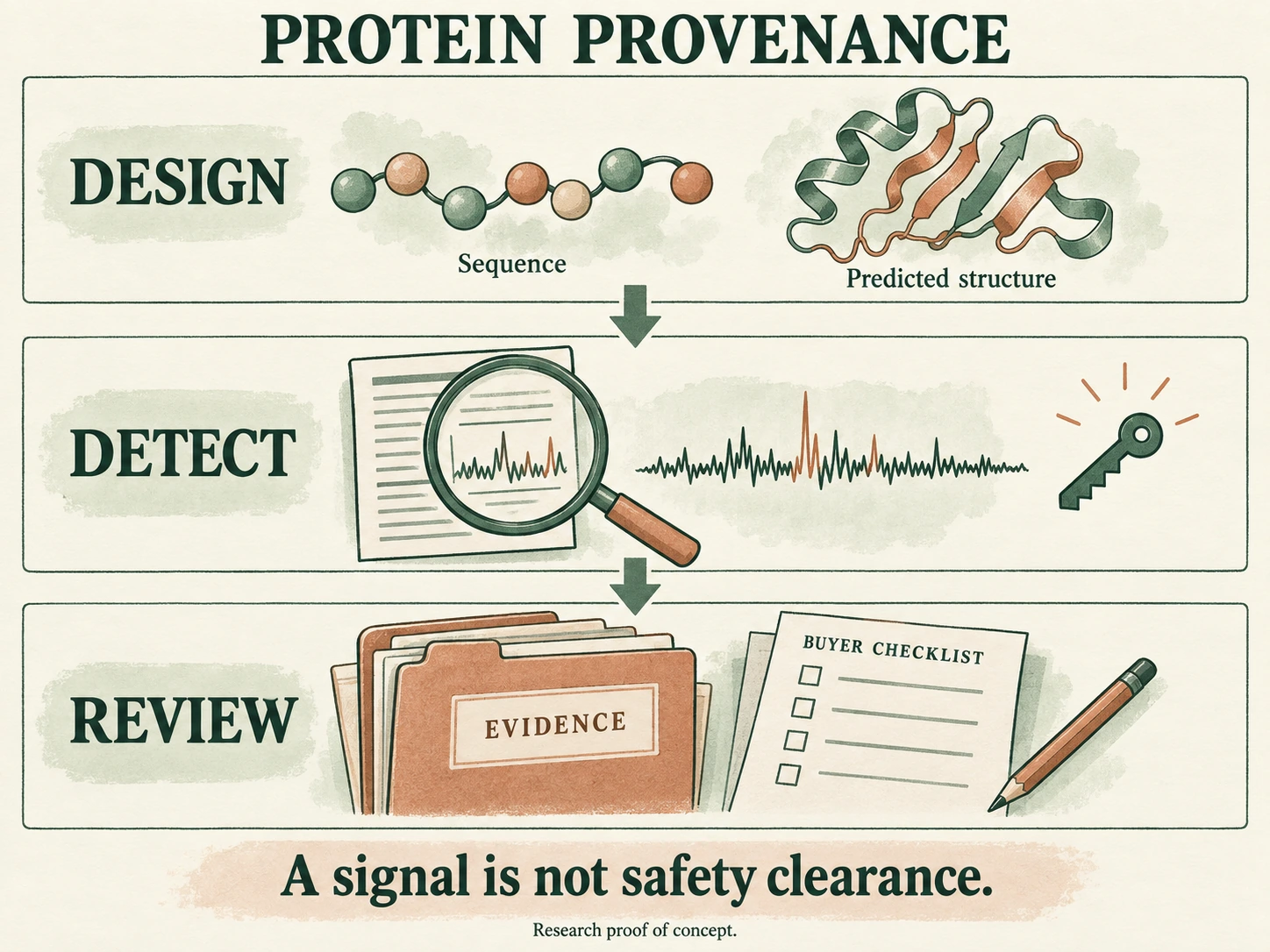
Google DeepMind announced SynthID Bio on September 30, 2026. The research explores provenance marks in AI-designed protein sequences and predicted structures. For biotechnology buyers, the useful question is whether a detectable mark provides enough evidence to influence a screening or procurement decision. The work is a proof of concept, with substantial limits on that use.
What changed on September 30
Announcement and paper publication: September 30, 2026. Analysis edition: October 1, 2026.
DeepMind’s announcement describes methods that embed signatures in protein sequences and predicted three-dimensional structures. It proposes applications in synthesis screening and scientific-database provenance. Those are proposed uses, rather than evidence of an operating screening service.
What the experiment establishes
The Nature paper reports wet-lab tests of designed binders against three protein targets. The authors found broadly comparable binding behavior, with some differences depending on the measurement threshold. The study does not establish preserved function across arbitrary biological designs.
The same paper reports that resequencing effectively removed the tested sequence watermark. Detection depends on controlled keys, and operational adoption requires further work and coordination. The researchers describe the work as a technical proof of concept. These are the authors’ results and limitations; Inquory has not replicated them.
Who can use the release?
The official research repository provides sequence-watermarking code and points to separate instructions for structure-model weights. Its setup is intended for researchers with a suitable computing environment.
The announcement provides no commercial screening-service offer, price, service-level commitment or production deployment date. Inquory’s interpretation: a research release gives a technical team material to evaluate. A buyer still needs a clearly described supported offering, applicable terms, integration requirements and cost before making an operating commitment.
A buyer’s evidence worksheet
Inquory’s proposed worksheet focuses on the decision a detector would influence. For example, a laboratory might use a provenance result to inform a reviewer’s assessment of a submitted design. This is a hypothetical workflow, not a tested customer implementation.
| Buyer question | Evidence to request |
|---|---|
| Which designs are covered? | Named generators, versions and object types, with evaluation data relevant to the proposed use. |
| How reliable is the result here? | False positives, missed detections and uncertainty on the buyer’s own representative records. |
| What happens after modification? | Documented robustness tests and handling of inconclusive results. |
| Who controls detection? | Key custody, authorized access, version changes and an audit trail for decisions. |
| What action follows a result? | A written review procedure, an accountable person and a fallback when the result is missing or uncertain. |
Inquory’s interpretation: keep provenance detection and the assessment of biological risk as separate decisions. A positive result should not automatically waive an existing review. An absent mark should not automatically classify a design as natural. Write down which evidence the reviewer needs alongside the detector result and how disagreements will be resolved.
Before buying or integrating a service, use the AI pilot measurement guide to define the baseline, review effort and acceptance criteria. The workflow review checklist can help assign responsibility for uncertain outcomes. These are general evaluation tools, not validation of SynthID Bio.
About this analysis
Inquory Research prepared this article with AI assistance and checked primary sources on October 1, 2026. We have not run the code, conducted biological experiments or validated detector performance, compatibility or cost. Research findings are attributed to their authors; the worksheet and business implications are Inquory’s proposed analysis.
The cover is an original AI-generated conceptual illustration. It is not a protein model, a laboratory photograph or evidence of an experiment. See our editorial method, AI-use disclosure and corrections policy.