Inside the workshop · October 23, 2026
A static gap passed.
The finished edges did not.
Two completed checkpoints separated source records from geometry, then tested jacket volume, one hair section and the skirt’s turned edges. Useful subpasses survived. No component did.
Follow the evidence ↓Our previous report ended with a smaller hair proof that still missed its strict geometry limit. V41 and V42 asked a different question: when a technical subcheck passes, what does the visible construction still have to prove?
V41 reconstructed and verified all 63 original B hair-root records without moving the geometry. V42 then cleared six source-identified jacket sites and found static clearance around B’s skirt. The new visible work still failed: the jacket retained deep body penetration, one hair section stayed mechanical, and the skirt’s new edges cut through themselves.
The root map was rebuilt. One section changed shape. Neither finished the hair.
V41 reconstructed and verified all 63 original source-root correspondence records to the exact retained V36 hair geometry. Across 91 frames, the maximum recorded root distance was 1.284737 mm, below the 1.5 mm scoped limit; barycentric bounds and sums passed, and the original root rings stayed unchanged.
That is a source-data repair, not a hairstyle repair. A separate V41 hair construction failed its attachment and appearance checks, so the metadata-only derivative stayed selected and the failed new geometry did not.
V42 then reshaped one existing 780-vertex section while retaining its root subcheck. The experiment stopped before bun expansion because the raised rear end still read as a pointed, flattened strip. Source correspondence survived; believable crown volume, gathering and a complete updo did not.
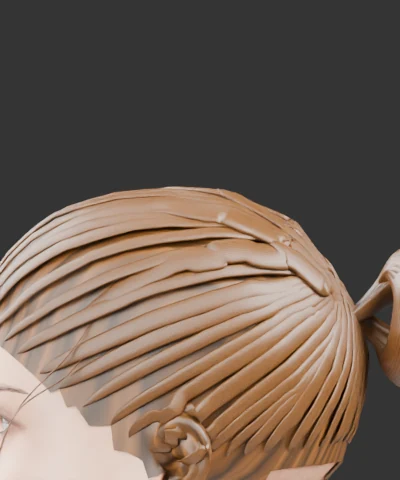
Retained V36 hair with V41 root metadata. All 63 root records passed while the original hair geometry remained unchanged, supplying the baseline for the V42 one-section test.
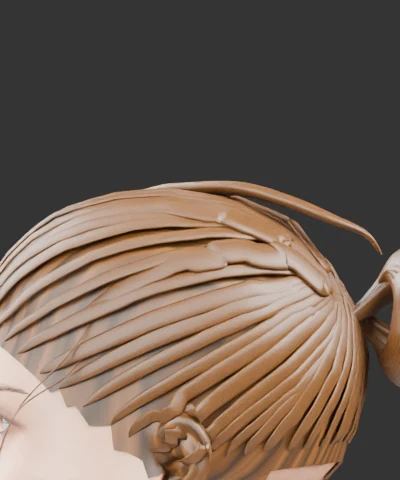
Rejected V42 local-section proof. The 780-vertex section retained a passing root subcheck, but the raised pointed strip remained flat and mechanical; no full updo was built.
Six named sites cleared. The affected region still entered the body.
V42 reconstructed A’s thickness stack, applied a pointwise boundary repair, then performed a shared-edge local retessellation. The original six source-identified sites cleared across eight sampled poses. The V42 diagnostic recorded 391 neutral finite triangle pairs, compared with 792 in V41; changed tessellation means those totals are not a like-for-like improvement measure.
Seventy-seven pairs remained in the affected region, and the signed estimate reached −1.531909 mm. Those counts are triangle-pair witnesses, not 391 unique contacts or visible defects. The result still establishes real body penetration, so the V42 jacket failed before the expensive 91-frame attachment and 126-pose export checks were run.
The earlier 91-frame and 126-pose passes remain evidence for their exact V41 source hashes only. They are not V42 derivative results.
| Lane | Scoped result | Construction result |
|---|---|---|
| V41 B root metadata | 63/63 records; unchanged geometry | Metadata pass only |
| V42 A jacket | 391 after retessellation; V41: 792, not like-for-like | Failed; 77 affected-region pairs remain |
| V42 B local hair | 780-vertex section; root subcheck passed | Failed silhouette; no full updo |
| V42 B skirt | 6.168550 mm static sampled clearance | Failed self-cuts, aperture and needle |
The static skirt gap passed. Its finishing geometry did not.
V42 added connected waist and hem returns, a thinner belt, a keeper and pin work. In the static sampled check, the minimum body clearance was 6.168550 mm, and five sampled poses reported no body cuts.
The finishing geometry failed elsewhere. Neutral self-pair witnesses increased from 628 to 1,208, the pin aperture failed, and a central needle artifact remained visible. Static body clearance could not qualify a skirt with self-cuts and an unusable fastening detail.
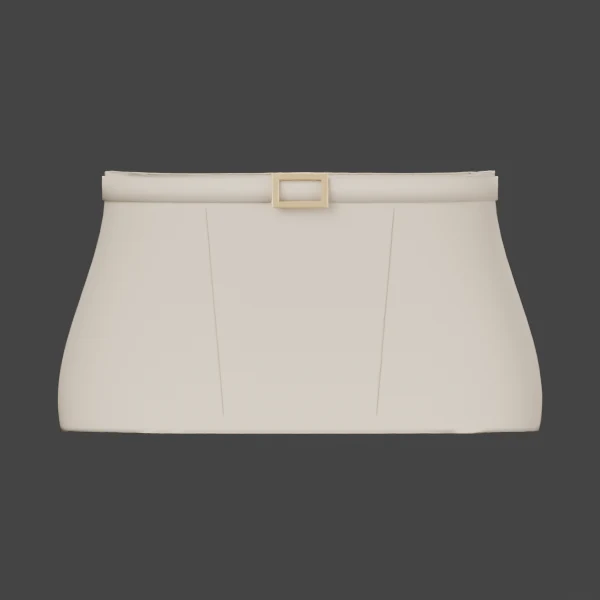
Retained V36 skirt baseline before the V42 turned-edge, belt and pin work.
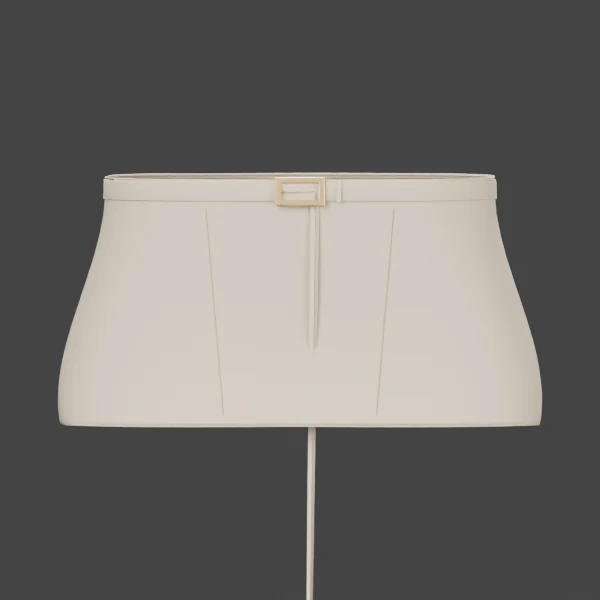
Rejected V42 skirt proof. Static sampled body clearance reached 6.168550 mm, while self-cuts, the failed pin aperture and the visible central needle kept the construction unusable.
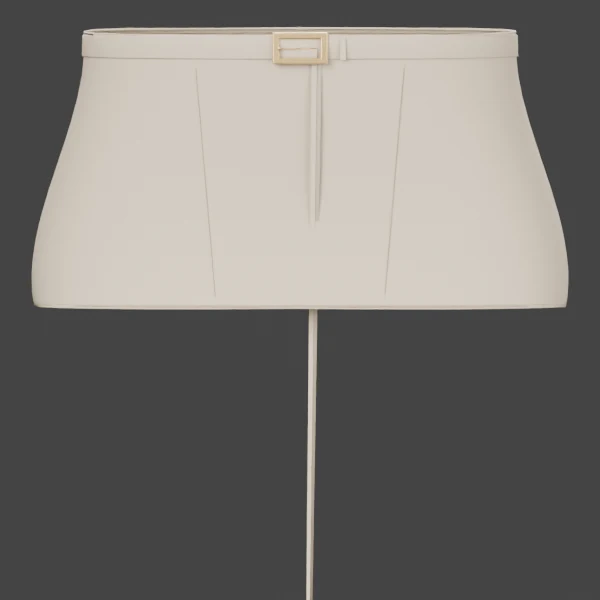
Rejected V42 hem detail. The static body gap passed, but new turned-edge self-cuts and the central needle artifact remained visible.
The result: clearing one boundary does not finish the construction around it.
Preserve the measurements. Rebuild the failing boundaries.
A’s next bounded construction must rebuild the remaining inner return and thickness relationship against the actual torso before repeating the 91-frame attachment and 126-pose export checks. B’s hair needs artist-controlled connected crown and side topology instead of another ribbon or lobe variation.
The skirt can retain its demonstrated matrix and barycentric repair, but its waist and hem folds, aperture and pin seating need new connected geometry before motion or export. V33 sustained foreground performance remains pending. Full motion, runtime and mobile qualification, GAME and Unreal integration, component licensing, and owner acceptance remain separate gates.
The subpasses narrowed the problem. The visible failures kept the components out.
Explore the full character workshop ↗All development updatesEvidence, image and rights notes
This first-party report covers completed R4-V41 and R4-V42 records. Numerical claims are scoped to their saved native and focused-result evidence; the page does not rerun Blender.
The five figures are actual local Blender renders of B. Hair images retain their native 400 × 480 composition; skirt images retain their native 600 × 600 composition. Mobile files are exact proportional reductions to 360 × 432 and 448 × 448. Nothing was cropped or enlarged. No image generation was used.
An independent image audit qualified these exact PNG sources for factual public illustration. The hair images retain the audited B body, locally created hair geometry and locally generated numeric fiber texture. The skirt images use the CC0 MRT mesh source and project-generated roughness and normal maps. This does not grant source-model redistribution or final game-use clearance. A remains text-only because its visible legacy hair and texture rights conflict is unresolved; comparison boards that embed the appearance reference are excluded.