Reversible editing
Six controls change actual evaluated body geometry; validated presets and full studio copies reopen with exact reset.
Inside the workshop · October 22, 2026
A local editable body foundation now makes the next artistic decisions possible. It also proves that changing a body changes every garment problem around it.
Follow the dependency ↓Our previous report ended with a surface that escaped the body and still failed as fabric. V29 and V30 then tested smaller coupled regions. One reduced stretch-and-clearance fixture passed, but the connected V30 fixture still measured 35 body pairs, 16 self pairs and a minimum signed distance of −4.971268 mm. Its stretch ranged from 0.289461× to 2.399498×.
That failure clarified a dependency we had deferred: before fitting a complete wardrobe, we need an intentional body target. V31 therefore builds an editable body foundation around the two preserved sources, then measures what those edits do to a lower-body preview. The result is useful precisely because the preview does not pass.
V29 reproduced the V28 failures and compared six smaller regions. V30 made hard-row feasibility reproducible and reduced the artificial isolated bust snap, but its joint field crossed the body. Neither checkpoint justified a whole-front solve.
A garment can only be fitted to a body state that has been chosen and preserved. Continuing to optimize clothing around provisional proportions would make every clearance, landmark and strain result temporary. V31 changes the order of work: establish reversible body controls first, then rebuild body-dependent garment evidence after a preferred target is reviewed.
The lesson: a body edit is not a cosmetic side task. It changes the geometry that collision, contact and fit depend on.
Both source bodies contain 19,158 vertices and 163-bone rigs, with 294 vertex groups and their existing shape keys, UVs and skin weights retained. Evaluated heights are 1.617863 m for A and 1.583931 m for B. Their inherited macro states already differ, so V31 records separate source hashes and never treats one body as the other’s default.
Six new relative shape keys sit above those sources. Zero returns the evaluated body exactly to baseline. Fresh native copies reopened with working deformation, a measured reset error of 0 mm and protected face vertices unchanged. This preserves the rig and topology; it does not certify the anatomy or every possible control combination.
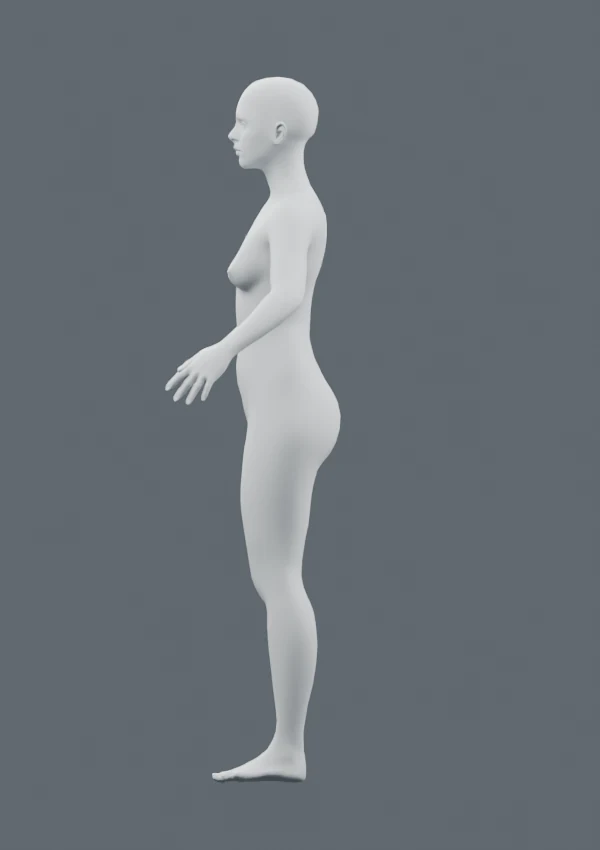
Receptionist A at the preserved baseline, shown in neutral clay from the side. This is an actual local Blender body study, not finished character art.
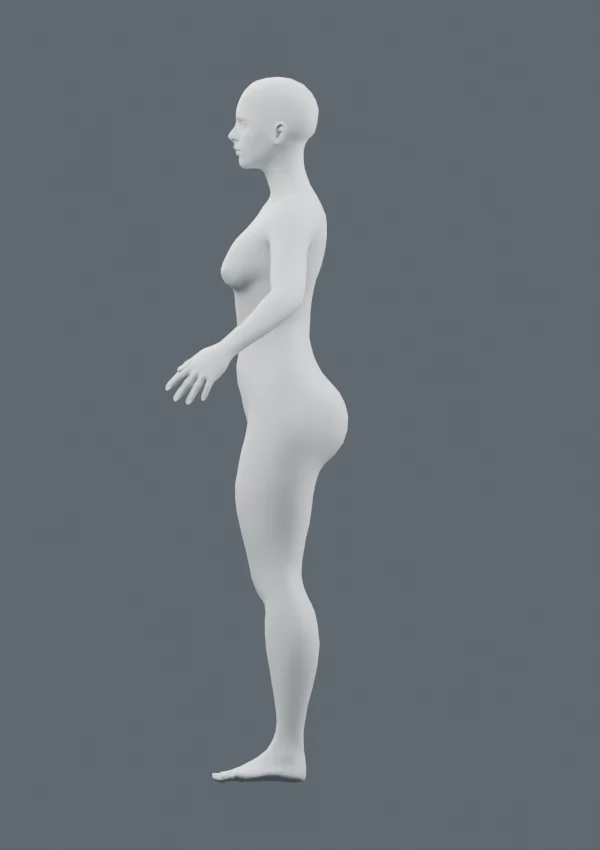
Receptionist A with the saved V31 draft preset under the same camera and lighting. Six regional controls change the body while preserving the original rig and source topology; the result remains an unapproved anatomical prototype.
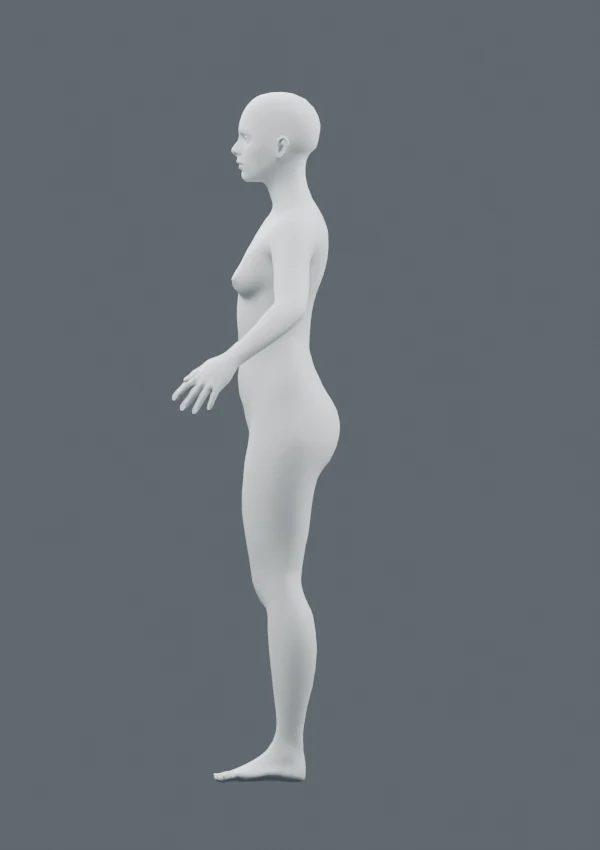
Receptionist B at the preserved baseline. The source already differs from A in height and inherited macro state, so the two bodies are audited and edited independently.
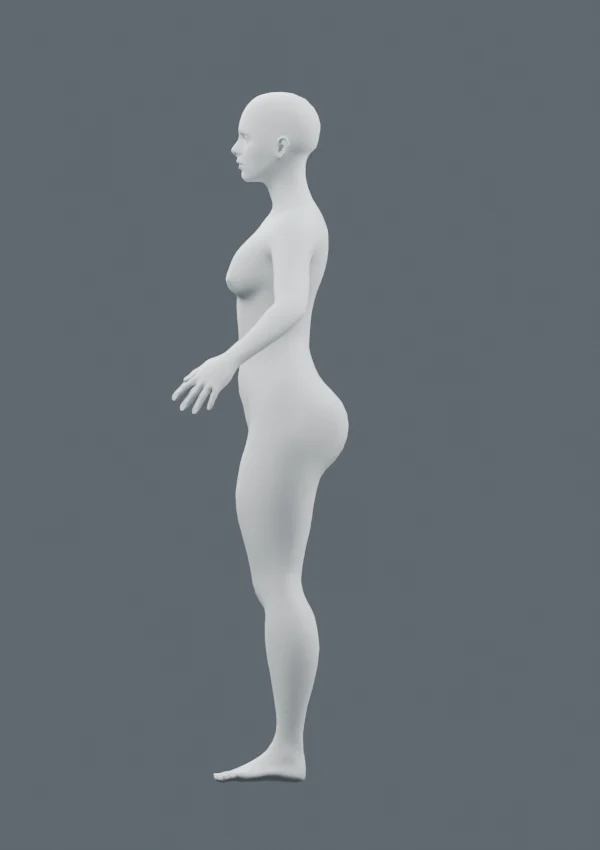
Receptionist B with the saved V31 draft preset. The matched view records a reversible body edit, not approval of the proportions, anatomy or wardrobe.
The V31 schema exposes breast fullness, glute volume, thigh thickness, calf development, hip width and waist shape. Each has a reversible 0–1 draft range, baseline and draft presets, plus editable custom JSON. The private Character Studio provides controls to switch A or B, compare original and current states, change four views, show the reference, toggle clothing and wireframe, recalculate the preview and save a full studio copy.
Background operator checks exercised body updates, preset save/load, source validation and exact reset. An update plus evaluated readback measured 31.90–62.20 ms across 20 local cases including dependency-graph work. That is not a foreground frame-rate or mobile benchmark. At the V31 checkpoint, physical mouse interaction and Blender’s Undo/Redo hotkeys were not tested.
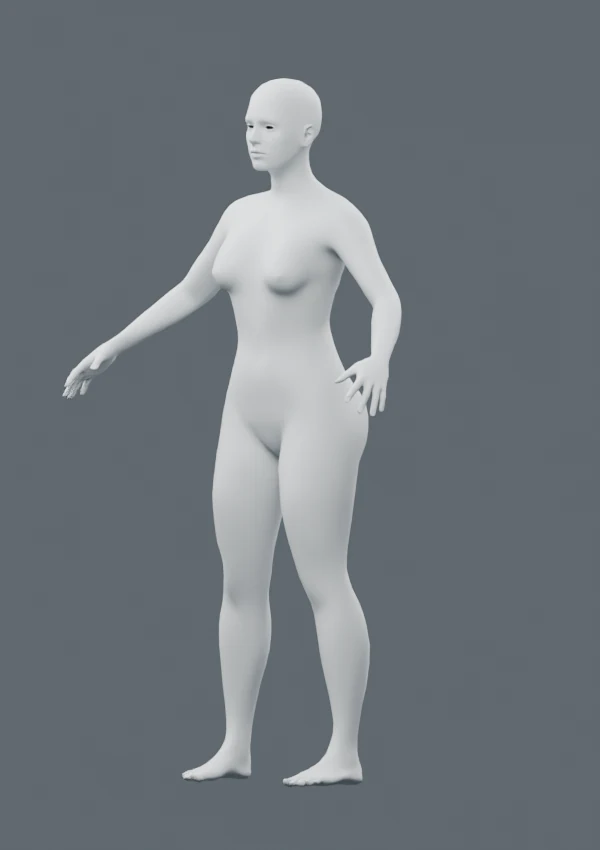
Receptionist A draft from the matched three-quarter camera. The preview makes regional changes visible without presenting this local private studio asset as a game-ready character or public download.
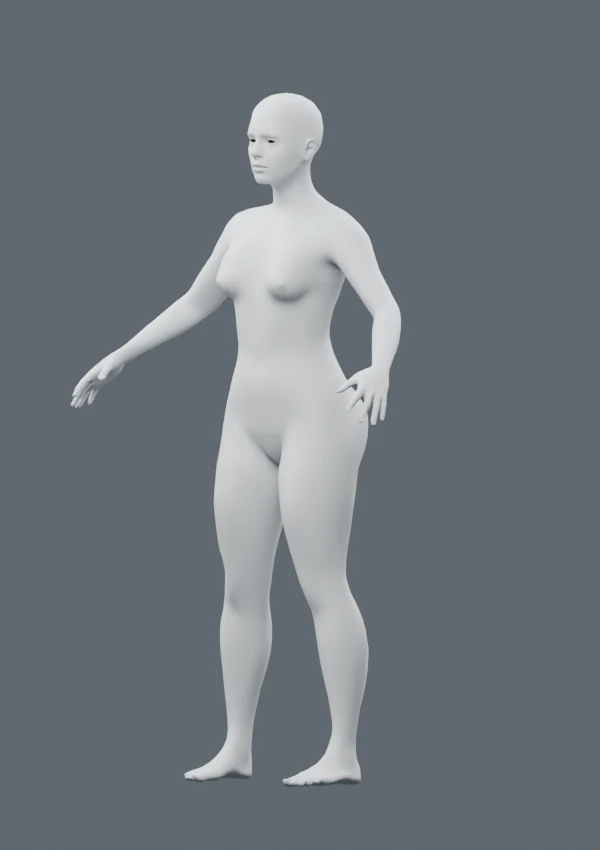
Receptionist B draft under the same three-quarter setup. A and B retain separate source hashes and presets rather than being treated as one interchangeable body.
Six controls change actual evaluated body geometry; validated presets and full studio copies reopen with exact reset.
Both original 163-bone contexts, topology, weights, UVs and existing shape keys remain bound to their own sources.
Neither draft body is approved. Feet, ankles, height and additional anatomy controls are not implemented.
A safe derivative of each earlier skirt follows the six body parameters through corresponding keys. That proves synchronization. It does not prove fit. At the draft preset, source-relative evaluated triangle strain spans 0.1413×–13.2095× for A and 0.0435×–6.5303× for B.
Those ranges include thin solidified boundary triangles and are diagnostic values, not fabric strain qualification. The standing static tests found zero body pairs, but excessive ease and invalid strain keep both results failed. A zero collision count cannot override the other measurements, just as it could not in V28.
| Body | Evaluated strain range | Static body pairs | Fit verified |
|---|---|---|---|
| A draft | 0.1413×–13.2095× | 0 | No |
| B draft | 0.0435×–6.5303× | 0 | No |
The lesson: synchronized geometry is only the start. Region-aware correspondence, garment ease and material-surface strain still need their own acceptance.
Six synthetic diagnostic pose states per body remained finite while preserving each original rig. Two saved sitting renders expose the more useful truth: visible upper-thigh compression, creasing and glute deformation need corrective sculpting and skinning review.
No production walk or sit action was authored. Body self contact, full joint-volume quality, facial animation, runtime behavior and mobile performance are not certified.
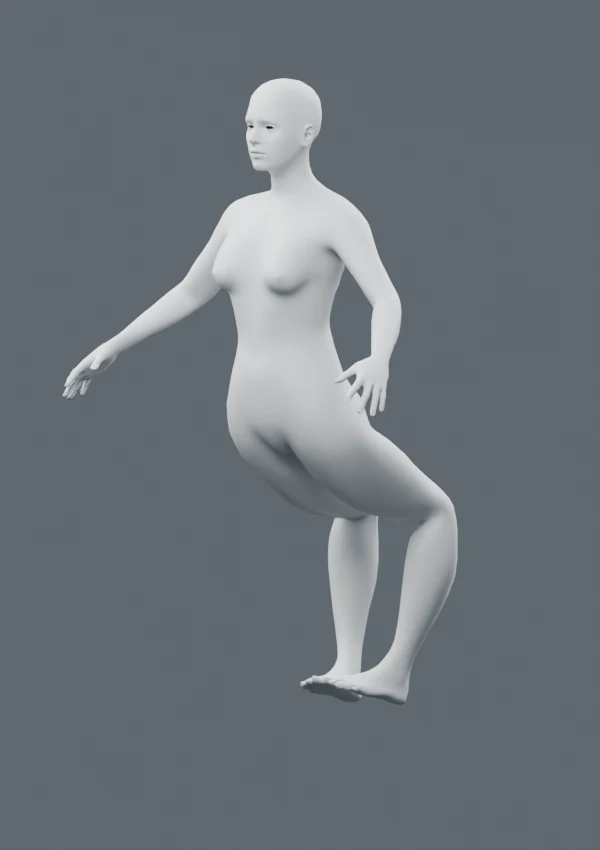
Receptionist A in the saved sitting diagnostic. Visible upper-thigh compression and glute deformation keep pose quality open even though the 163-bone rig remains preserved.
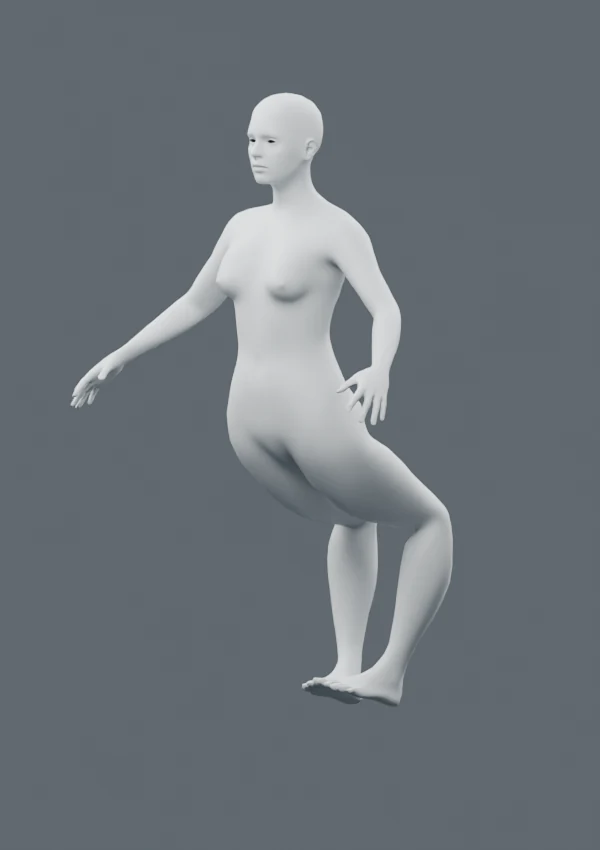
Receptionist B in the corresponding sitting diagnostic. This static render exposes work for corrective sculpting and skinning; no production sit animation was authored or accepted.
The next meaningful decision is visual: inspect A and B in the private studio, adjust the proportions and save a preferred preset for review. After that selection, the lower wardrobe needs region-aware correspondence and material-control-surface strain evaluation. Body landmarks, normals, collision geometry and every body-dependent garment result must be reconstructed for the chosen state.
The upper prototype remains blocked because the first garment-fit gate failed, and full-blouse fitting remains paused until body approval. V31 does not make either receptionist complete. It makes the dependency visible and gives the next review an editable, reproducible foundation.
Later V32 usability caution · October 22: the reported approximately 60-second owner freeze was not reproduced, and its root cause remains unresolved. V32 removed synchronous detailed validation from the editor, excluded the inactive character collection and defaulted to a body-only preview. Limited foreground work observed a numeric edit, character switch, reset and Undo; it did not qualify continuous dragging, Redo, a cold launcher run or the final byte revision. Sustained foreground editing is the next gate before body selection or blouse work resumes.
Choose the body before asking the wardrobe to fit it.
Explore the full character workshop ↗All development updatesThis first-party report covers the V29–V31 body foundation with subsequent V32 usability caution. Its eight-image visual record remains bound to completed R4-V29, R4-V30 and R4-V31 work from October 22, 2026. The later note is limited to V32 progress, foreground, performance and raw interaction evidence; it adds no new artwork and makes no complete character, game integration, GPU or broad performance claim.
All eight figures are actual saved local Blender renders. The responsive WebPs retain each 600 × 850 full composition; the 420 × 595 mobile files are proportional reductions with no crop or upscale. No AI images were generated for this report. The private source retains its existing MPFB/A6/B7 restrictions, while skirt derivatives retain their V05 source metadata and restrictions; publication of these renders does not grant blanket redistribution of the models.