Posterior shoulder
0.300011662 mm mismatch, with the 34-station residual within 0.000007451 mm.
Inside the workshop · October 22, 2026
Two completed checkpoints test a hard distinction: removing intersections with the body does not make a surface wearable.
Follow the evidence ↓Our previous modelling report stopped at V26 with a continuous anatomical map and a sparse sliding witness, but no front panel. V27 and V28 asked the next question: could the bounded front study be placed outside the body without destroying the dimensions and behavior that fabric needs?
The answer was useful because it was not simple. V28 reduced the tested body-intersection count from 300 pairs to zero. It also exposed 44 self-intersection pairs, extensive stretch failure and less than one third of the required minimum clearance. The green collision map records a real improvement. It does not certify a garment.
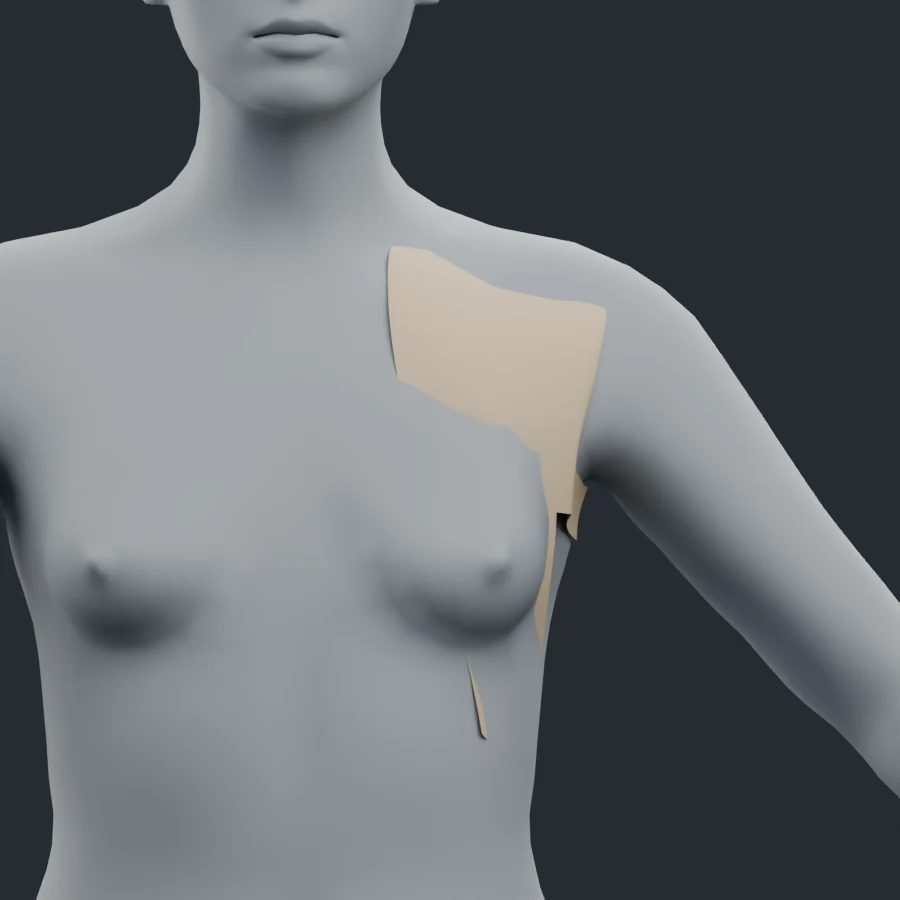
V27 began with a bounded posterior shoulder problem inherited from V15. The placed front and posterior sewing lengths differed by 1.353048 mm, above the existing 1 mm limit. A correction moved 204 vertices while preserving the qualified posterior surface and the original pattern. The resulting mismatch was 0.300011662 mm, and the 34-station residual remained within 0.000007451 mm.
That is a passed subgate for one shoulder interface. It does not qualify the separately constructed front surface or the blouse as a whole.
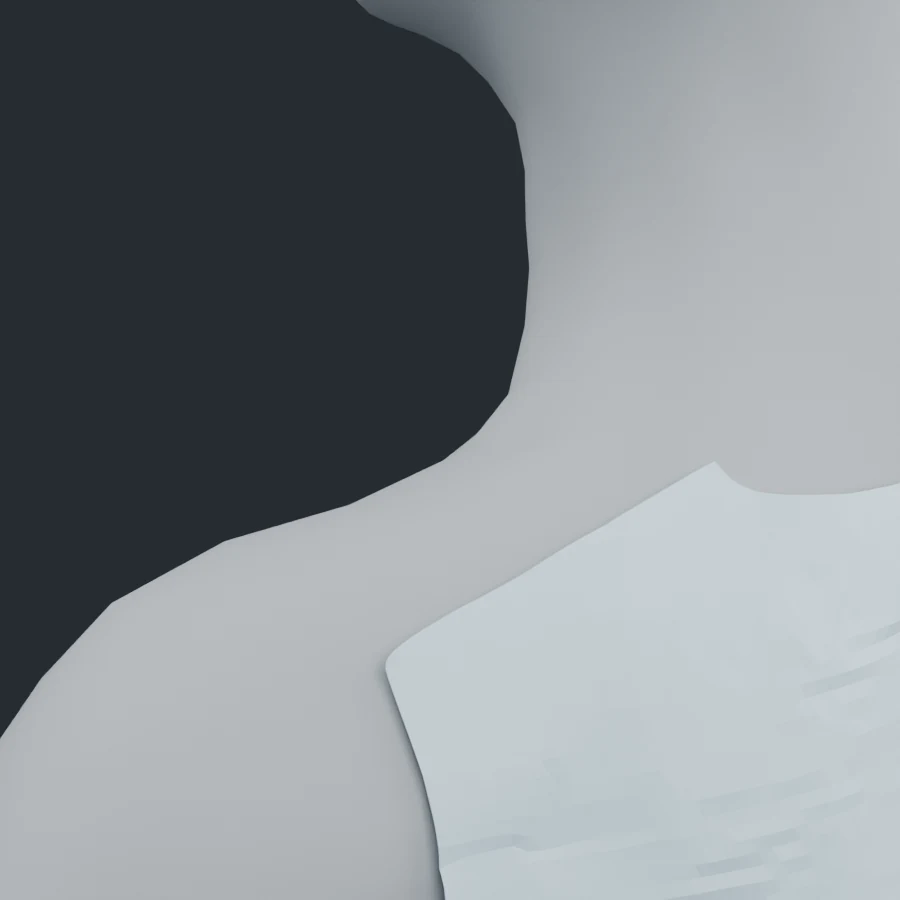
Before V27: the saved V15 posterior shoulder under the matched camera. Its 1.353048 mm sewing-length mismatch still exceeded the 1 mm bounded gate.
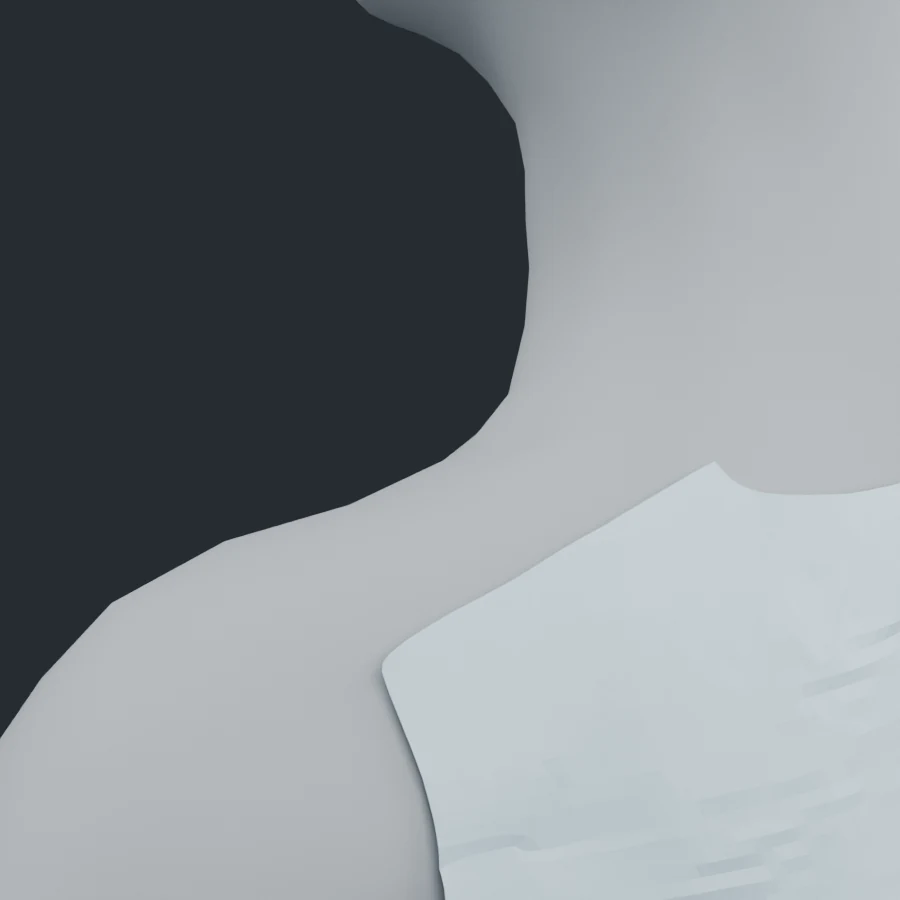
After the bounded posterior correction: the same saved shoulder view with mismatch reduced to 0.300011662 mm. This passes the posterior subgate only; it is not a front panel or finished blouse.
The lesson: keep a local repair local. A shoulder pass is evidence about the shoulder, not permission to promote the whole garment.
The V27 static front retained 2,099 source vertices and 3,921 triangles. Its sparse interpolation matched the selected samples, then crossed the body between them. Saved native testing counted 300 body-triangle intersection pairs and 1,216 penetrating vertices. The minimum signed sampled clearance was −38.465186 mm; maximum and mean unsigned distances were 38.465180 mm and 8.052514 mm.
Its principal stretch ranged from 0.139533481× to 1.852438648×. Of the 3,921 triangles, 483 fell below 0.5× and 3,180 exceeded 1.5×. All faces also shared a global inward orientation convention. That is one global winding error across 3,921 source triangles, not 3,921 separate folds.
V28 used one fixed 1,600-iteration run. It took 91.63 seconds, with no parameter sweep, restart or geometry repair. The saved derivative kept the same 2,099 vertices, 3,921 triangles, material identities and corresponding UV corners under one global face-corner permutation.
On the bounded static tests, body intersections fell from 300 pairs to zero, and penetrating vertices fell from 1,216 to zero. Minimum signed sampled clearance rose to 0.314116 mm. Yet the existing requirement is at least 1 mm, and the limited 12,039-point sampling does not certify continuous clearance. Maximum and mean unsigned sampled distances remained 7.836500 mm and 2.266986 mm.
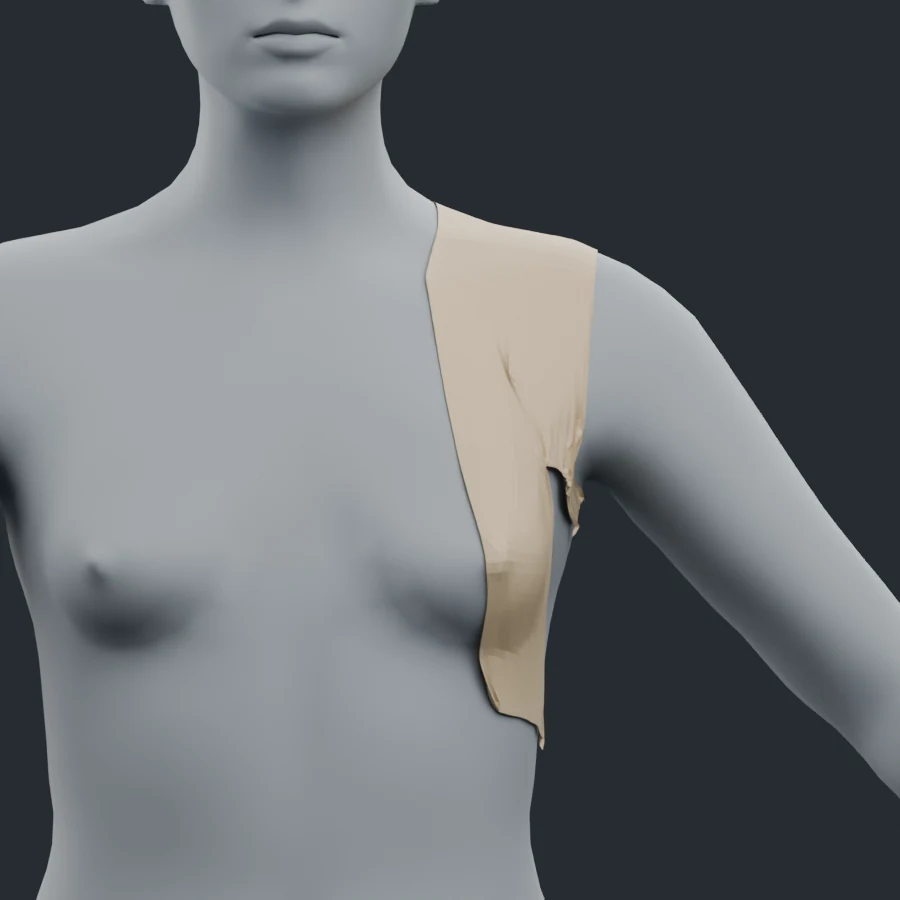
V28 under the identical camera: tested body intersections fall to zero, while axilla corrugation, chest creasing and a faceted bust remain visible. Zero body pairs is not garment fit.
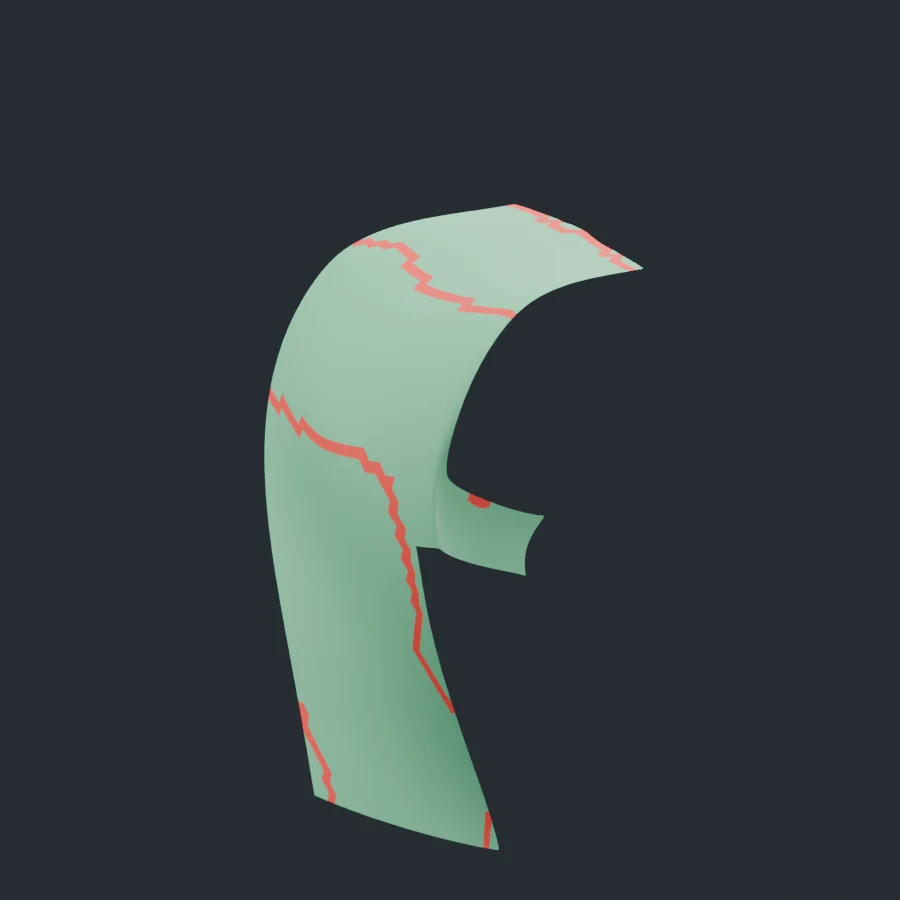
V27 body-collision diagnostic with the body hidden: red marks triangles involved in tested body intersections. The diagnostic says nothing about strain or continuous clearance.
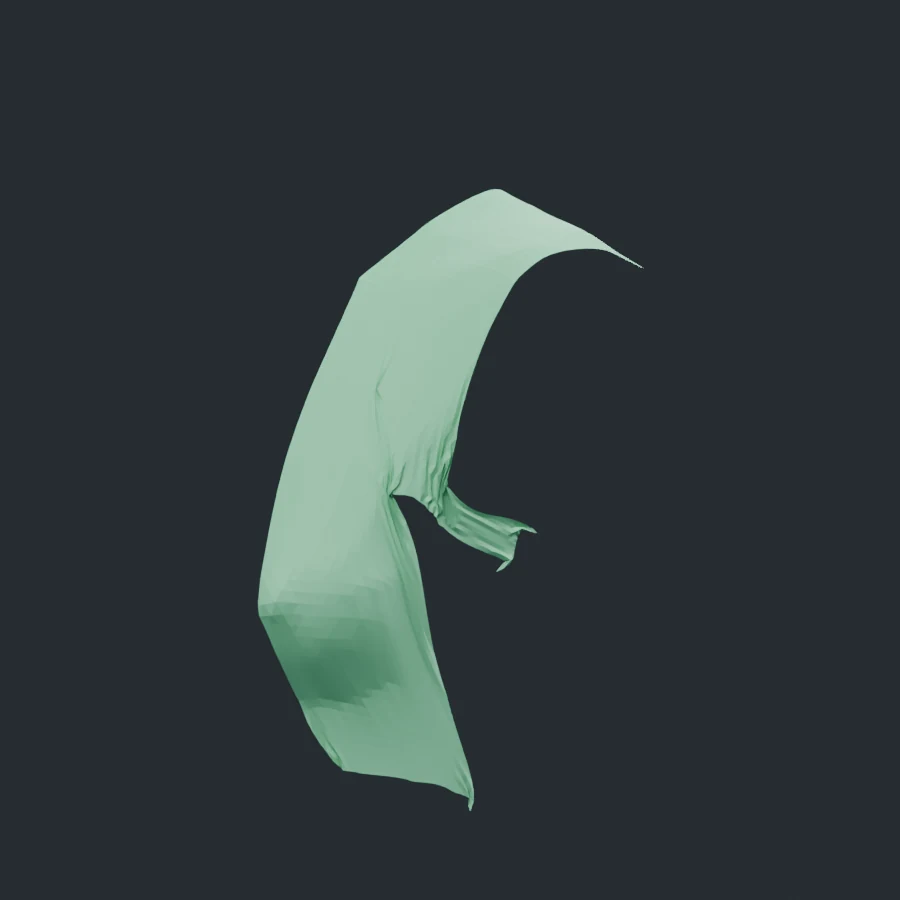
V28 body-collision diagnostic: no tested body-intersection triangles remain, so the surface is green. It still fails minimum clearance, self contact, strain and local orientation.
The lesson: name the test that passed. Zero tested body-intersection pairs does not mean collision free, comfortably clear or wearable.
The V28 principal stretch range narrowed to 0.313604803×–1.897850240×, but the required band is 0.5×–1.5×. Saved-native readback found 10 overcompressed triangles and 1,414 overextended triangles; both required counts are zero. The authoring iteration had reported 1,413 above the upper limit, but the saved native value of 1,414 governs this report.
The global face order was corrected, while 15 locally inward triangles and 131 adjacent normal turns above 90 degrees remained. Nonincident self contact also regressed from zero tested pairs to 44. The images show the physical character of those numbers: a corrugated underarm, pointed curled ends, a faceted bust and a residual chest crease.
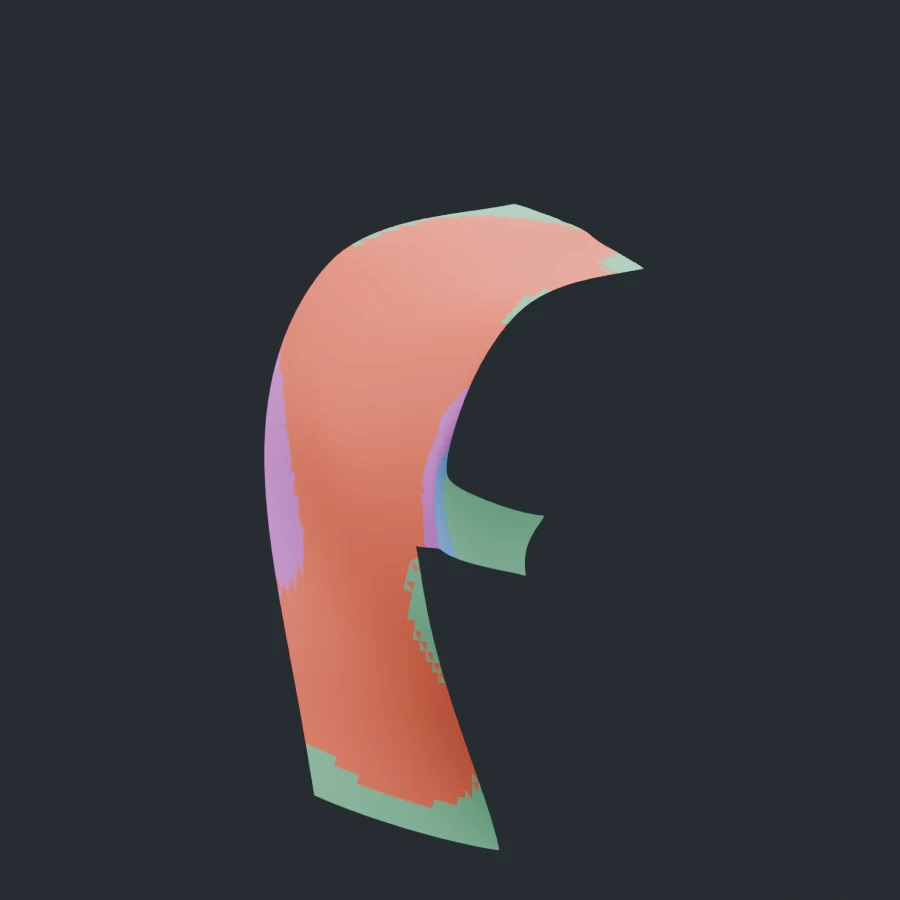
V27 strain diagnostic: red is extension beyond 1.5×, blue is compression below 0.5× and purple fails both directions. The initial front failed across most of the bounded crop.
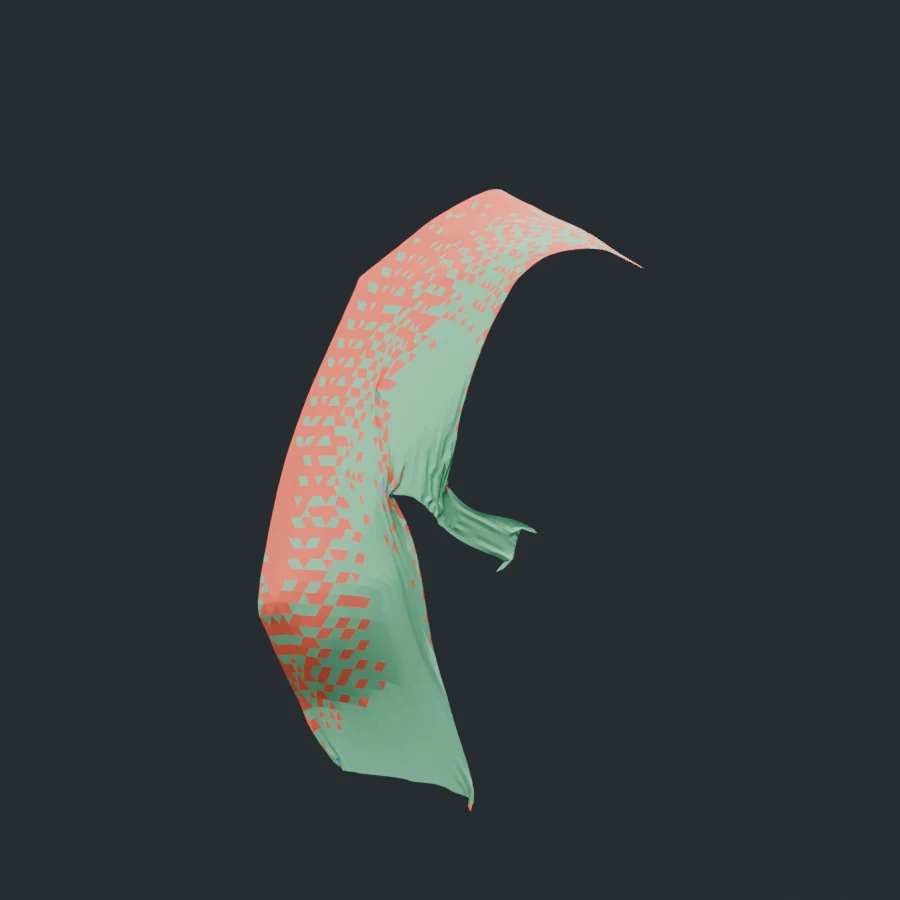
V28 strain diagnostic: the failure area changes but remains extensive. Saved-native readback found 1,414 overextended and 10 overcompressed triangles, with stretch spanning 0.313605× to 1.897850×.
| Check | V27 | V28 | Requirement |
|---|---|---|---|
| Body intersection pairs | 300 | 0 | 0 |
| Self-intersection pairs | 0 | 44 | 0 |
| Stretch below / above band | 483 / 3,180 | 10 / 1,414 | 0 / 0 |
| Minimum sampled clearance | −38.465186 mm | 0.314116 mm | ≥ 1 mm |
| Inward faces / sharp adjacent pairs | 3,921 / 0 | 15 / 131 | 0 / 0 |
Eight of nine controls landed within an eligible regional relation, but only four of nine matched their explicitly stored bindings. Five failed, and the maximum binding residual was 22.621403 mm. One optional control labelled “bust” also missed its actual eligible region; in this bounded crop it is an upper-chest chart control, not the authored bust point or completed dart construction.
These checks do not certify a continuous optimizer trajectory. They also do not prove that the original blouse pattern is impossible. The independent projection schedule tested one bounded construction; it did not explore every feasible surface or construct a coupled cloth solution.
0.300011662 mm mismatch, with the 34-station residual within 0.000007451 mm.
Zero tested body-triangle pairs and zero penetrating vertices in the saved V28 static surface.
Self contact, strain, minimum clearance, local orientation and visible surface quality remain outside their gates.
A useful next attempt must treat strain, body clearance, self contact and sliding relations as coupled constraints. Optimizing one after the others can trade a red collision map for folds, sharp turns and overstretched material. V27 and V28 make that trade visible without mistaking a diagnostic surface for clothing.
This snapshot ends with completed V28 evidence. V29 work is excluded. The recorded artistic state remains 0 of 11 components ready for review and 0 of 11 owner accepted.
A green map can still describe failed fabric.
Explore the full character workshop ↗All development updatesThis first-party report covers completed R4-V27 and R4-V28 records from October 22, 2026. It was checked against saved progress records, certifications, native readback, comparison metrics and render receipts. V29 is outside this evidence edition. The page does not rerun Blender or certify work beyond V28.
All eight figures are actual local Blender renders of saved geometry or diagnostics. The responsive WebP files retain each full composition with proportional resizing and no crop. No new AI images were generated. Editorial preparation used AI assistance; the account preserves failed gates and separates engineering measurements from artistic acceptance and game integration.