Inside the workshop · October 23, 2026
The contact cleared.
The silhouette still failed.
Two completed checkpoints tested real native tools, then applied bounded repairs to A’s jacket and B’s hair. Contact evidence improved. Neither visible construction became a review-ready component.
Follow the evidence ↓Our previous report ended with contact still inside A’s jacket and one reshaped B hair section still reading as a strip. V43 tested native garment and hair operations against the actual source. V44 then kept the usable mechanisms and asked whether measured repair could survive visible construction.
It could survive some contact checks. It could not finish the art. A’s affected jacket region became body-clear across eight sampled poses, but the cloth puckered and crossed itself. B’s five guides cleared their scoped 91-frame checks, while a larger connected section twisted into the inherited hairstyle and was rejected.
The native tools worked. Their first proofs stayed small.
V43 demonstrated a real MCP SDK connection to an isolated Blender 5.2.1 session, then exercised source-bound native operations without changing desktop registration. OpenSew welded 27 exact A source seams into a small proof with one connected component, no loose or invalid edges, no zero-area faces, zero finite torso cuts and 2.016160 mm minimum sampled clearance.
That proof did not reconstruct original polygon 1544, add UVs or skinning, or build a finished jacket. On B, five native Hair Curves guides retained a 1.100214 mm maximum root distance across 91 frames, but four buried samples and two exact scalp segment cuts remained in each sampled diagnostic pose. The activated native Comb stroke returned PASS_THROUGH with zero movement. V43 established working operations and clear limits, not artistic completion.
A’s affected jacket region cleared the body. The cloth folded into itself.
V44 applied native cloth to A’s real contact-scale source panels. In the same eight sampled poses, the complete evaluated affected thickness recorded zero finite body pairs and zero buried samples, with 0.508192 mm minimum sampled clearance against a 0.5 mm scoped limit. An explicit evaluated-face lineage check also bound original polygon 1544: 224 thickness triangles, 1,568 samples, 1.472298 mm neutral minimum and zero finite body pairs.
Attachment subchecks survived the repair. The frozen 91-frame all-surface probe reached 0.650717 mm, the sewn-row probe reached 0.374221 mm, and a separate 27-seam probe reached 0.000123 mm. Those are bounded measurements. Global retained-shell body pairs remained 314–331, so they do not establish whole-character clearance.
The visible and relational failures were decisive. Neutral affected self-crossing pairs rose from 43 to 249, and facing-to-shell pairs rose from 163 to 391 pending physical classification. The native cloth principal curled the hem 94.101 mm and displaced fastening fabric 4.767948 mm; a repair reduced maximum relaxed motion to 12.982344 mm while retaining severe side puckering, an angular lower return and unfinished layering. No post-failure 126-pose or GLB qualification was run.
| Lane | Scoped result | Component result |
|---|---|---|
| V43 A OpenSew proof | 27 seams; 2.016160 mm sampled clearance | Small proof only; no 1544 reconstruction |
| V44 A native cloth | 0/77 affected body pairs across 8 poses | Failed self-contact and visible tailoring |
| V44 B guide repair | 5 guides; 0 cuts across 91 frames | Scoped guide pass; no full hairstyle |
| V44 B connected section | Manifold section; roots within 1.284737 mm | Failed crossings and naturalness |
Nine control edits removed two guide cuts. Five guides still were not hair.
V44 replaced the no-op brush path with explicit curve-control edits in measured scalp-local normal frames. Nine controls on guide 2 moved by at most 3.8 mm, while the five roots, body, rig and all 35 source meshes stayed exact in fresh readback.
Across all 91 evaluated head-turn and neck frames, the maximum root distance was 1.100214 mm against the unchanged 1.5 mm limit. No guide point was buried, no full guide segment hit the body, and minimum signed point clearance was 0.994818 mm. That closes the scoped V43 crossings. The sparse guides still float at the inherited gathering and do not form a natural updo or GLB hairstyle.
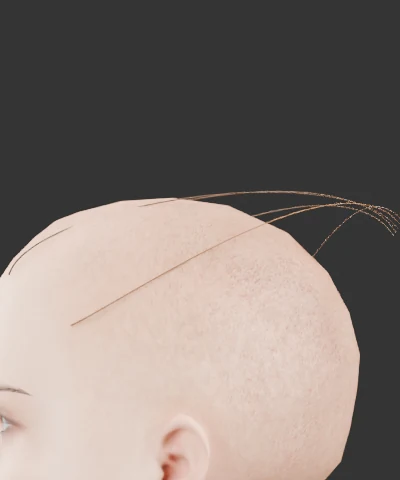
V43 guide state before repair. One guide retained two measured scalp segment cuts in the 91-frame probe; the native Comb attempt had produced no control-point change.
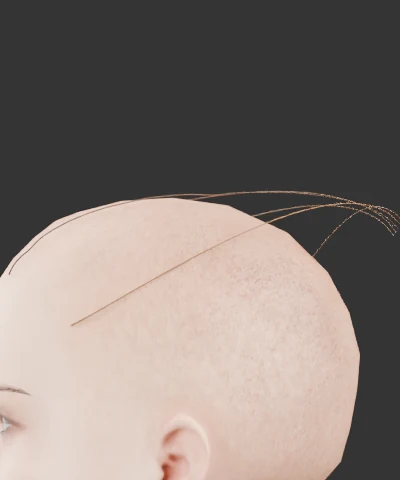
V44 guide state after nine measured control edits on guide 2. The scoped 91-frame root and scalp checks pass, while the five sparse guides remain only an editable study.
The connected section became one mesh. Its shape became the blocker.
A separate V44 construction joined original major-sweep sections 1 and 2 through an explicit two-root Y junction. It retained 3,324 original vertices and 3,272 face-corner UV records, changed 888 retained vertices, introduced 576 continuation vertices, and preserved the other 34 meshes, rig and four face-framing locks. The selected section was one closed component with zero nonmanifold edges, zero zero-area faces and zero loose vertices.
Those structural checks did not rescue the result. Five sampled poses reported zero body pairs, while each pose retained 153 self pairs, 501 pairs with other major sweeps and 2,659 crown-side pairs. These are triangle-pair witnesses, not unique visible defects. Matched views show the actual problem: a twisted entrance, lumpy mechanical merge and blunt raised rear continuation. The experiment stopped before expansion or export, and the V36 geometry with V41 metadata remains selected.
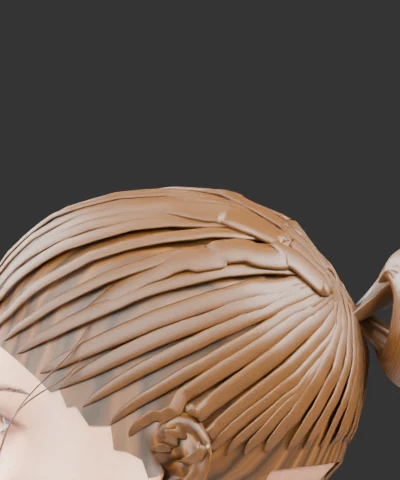
Retained V36 source geometry with V41 root metadata. This remains the selected fallback after the V44 connected-section experiment failed.
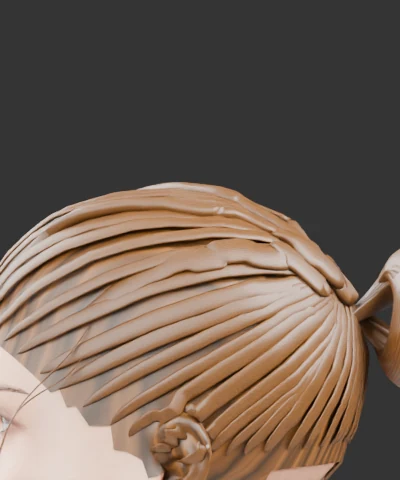
Rejected V44 connected-section side view. The new Y-junction is manifold and body-clear in five sampled poses, but its entrance twists into a lumpy mechanical merge.
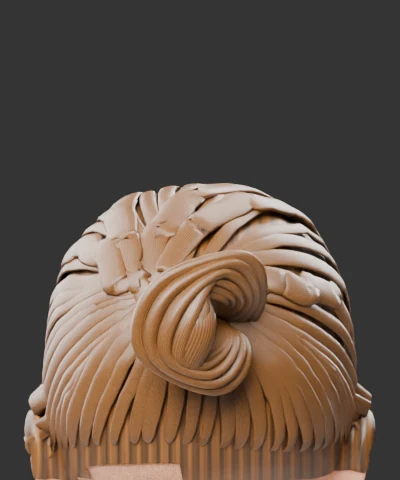
Retained V36 rear construction before joining two root sections into the rejected V44 continuation.
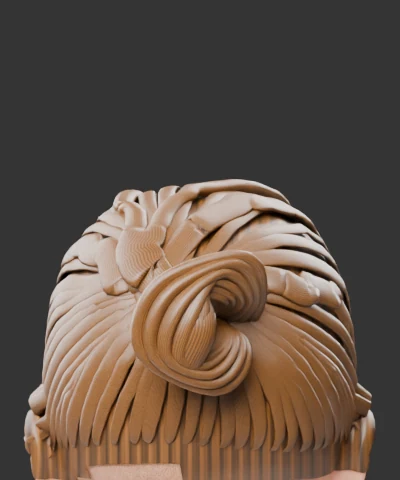
Rejected V44 rear view. The blunt raised continuation failed natural directional volume, while saved checks recorded self and intercomponent crossings.
The result: contact and topology can pass their scoped tests while the component still fails as design.
Keep the verified mechanisms. Replace the failing construction.
A now needs deliberate garment panel boundaries and a smooth continuous return that preserves the affected clearance and attachment evidence without the self-folds, puckering or angular hem. B needs artist-controlled directional volume and an intersection-free gathering beyond the five-guide study; another no-op brush request or cosmetic parameter sweep would not answer the visible failure.
No new complete-character GLB, 126-pose transport, native Unreal import, runtime, mobile, R3 retarget or GAME integration was qualified from these V44 derivatives. V33 sustained foreground performance remains pending owner testing. Per-file component licensing and final appearance acceptance remain open.
The useful measurements survived. The rejected shapes stayed out.
Explore the full character workshop ↗All development updatesEvidence, image and rights notes
This first-party report covers completed R4-V43 and R4-V44 records. Numerical claims are scoped to their saved native and focused-result evidence; the page does not rerun Blender or transfer a pass between source hashes.
The six figures are exact local Blender renders of B at their native 400 × 480 composition. Mobile files are proportional 360 × 432 reductions. Nothing was cropped or enlarged, and no image generation was used. A remains text-only because its full-composition renders expose inherited hair and textures whose per-file commercial clearance remains unresolved.
B’s shown body and inherited V36 hairstyle remain bound to the previously audited per-file provenance; V44 adds project-authored guide controls and connected-section geometry and no new texture. Publication of these diagnostic renders does not grant source-model redistribution, commercial game clearance for every inherited component, integration approval or owner appearance acceptance. The appearance reference is not reproduced.